
It’s finally here!
Today the reality of camera-scanning is here with the onset of 100 to 400 mpx digital camera systems and “CAS” (Continuous Aberration Suppression) macro lenses that resolve detail below 2.5um across the entire sensor while scanning different film dimensions.
All scans are full-frame, perfectly flat, and grain sharp. All scans are between 100mpx and 400mpx in size (whatever is appropriate for capturing all film detail and tonal depth). Skip the talk, jump to prices ->
We offer two types of scans . . .
RAW SCANS are just that, we focus and capture the negative and we send that file without touching it. We air-dust the neg before capture but do not dust-bust the scan after capture. These scans are for those who want super high resolution files on a budget. Basically this is for artists who are used to Flextight/raw scanning at lower-resolution but are not going to invest $20,000 in hardware necessary for this type of capture.**
With MASTER SCANS we go several steps further. Utilizing 20 years of experience with fine art imaging and film scanning, we clean and “pre-master” your scan file. You get a perfectly clean “flat-contrast” image file ready for final color and tonal grading.
All scans are 16bit (48bit RGB) PSB or TIF files with a raw smart-object base layer.
The video below shows a raw scan opened and focus checked. No auto sharpening is applied to the raw file. The negative is an old and dusty one from 1948. An initial curve is applied and dust-busting is started. The pre-mastering process includes a full dust bust and one or two global contrast/color curve layers.
Serious quality . . .
All scans are capable of being printed up to 60×80 inches (or more). This is because our capture quality is at or above the highest resolution drum scans out there. For example, a 35mm can be scanned at approximately 10,000ppi (optical) while even the Scanmate 11000 drum scanner is only interpolating a 5000ppi scan up to 11000ppi by slowing the step motor and increasing the pixel capture. 8×10 film capture with our system is at approximately 2200ppi, larger than the maximum pixel dimensions or TIF sizes from the leading drum scanners today. Because we are shooting with a camera, even the most over-exposed negs can be scanned with bracket shots to get through the very opaque material while maintaining delicate detail throughout the histogram. On drum scanners the film can be double-exposed but this affects the over-all tonal range and color compression and leads to degradation of other parts of the scan. While our prices are way way below drum scans, our quality is at or above drum scans and our turnaround is faster.
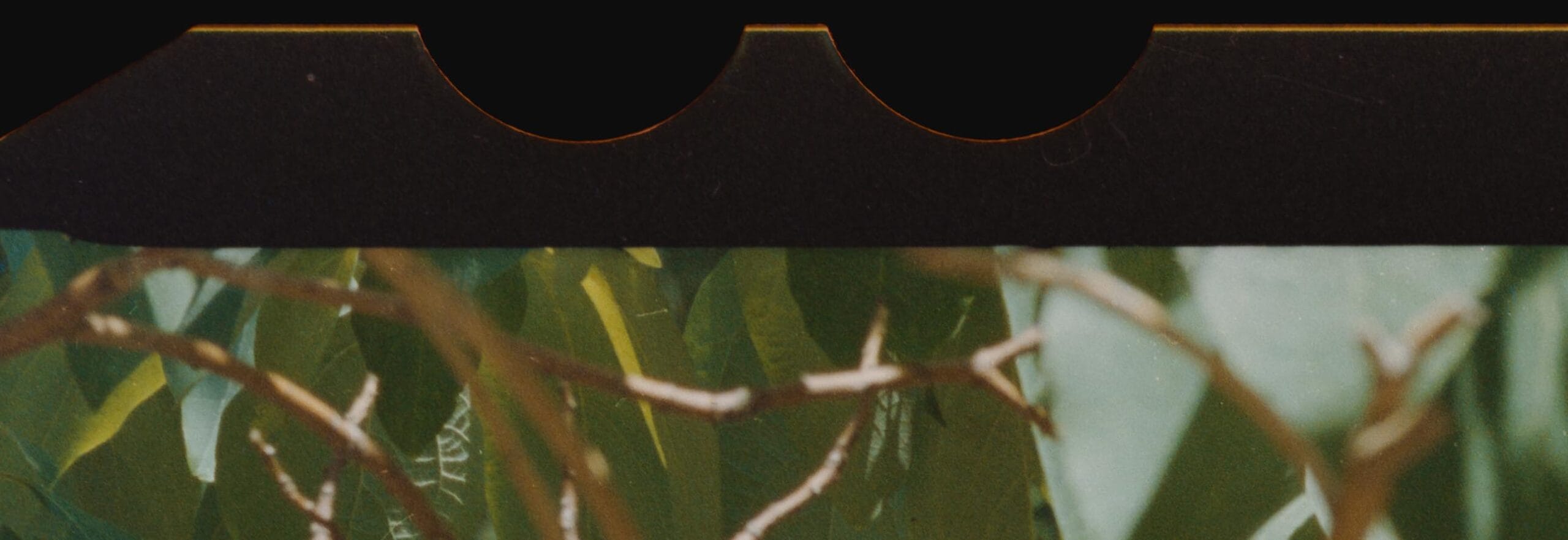
A very good way to see the quality of a capture is to view the very edge of a large format color film scan. Most drum scanners are not leveled or their drums are no longer weighted properly. This results in every other pixel line being off by 2 or more pixels and a very jagged edge to both the image and internal contrast lines (hair, fence posts, tree branches, etc). The image below shows a top left film edge from a roughly 300mpx 4×5 film scan at 200% zoom. There is no shake or movement in a camera scanning system. Every bit of the film is captured in the right XY orientation and this results in better and smoother grain resolve. The actual grain of the neg has been scanned sharp. No extra sharpening was applied to the negative. A small amount of color noise reduction was applied in raw before inversion (we do this standard).
Secure film transport is available . . .
The main worry for artists who live far away from our studio and who are sending any type of film by carrier is that it will be damaged or lost. We provide a lockable AirTag’d Pelican Vault case for artists wishing for that peace of mind. We share the AirTag location with the artist before they load their film and they can track it anywhere on planet earth from their studio to ours and back the entire time. The Pelican Vault is fire/water/impact proof.
We can scan a lot of film per day . . .
When film is properly organized, we can raw-scan up to 300 originals per day. The inversion and cleaning of the files takes longer but if you are traveling to us with a bunch of negatives, you only have to stay for a day and then you can travel back with the negs and we can master them over the following few days.
Want to have both scans and photogravure/inkjet prints done in the same day?
No problem. Because the scanning is about 120 times faster than a drum scanner, and because we are very efficient at getting the file where an artist needs it, and because we are extremely good at printing at quality and speed, we can pull a few scans, clean and master them with the artist in-studio, and get some photogravures or high-end inkjet prints done all in a day.
For more complex jobs with thousands of negatives we can travel to you.
Our entire scanning system can fit into a few suitcases (or UPS boxes) and be carried and operated by one person. For large complex jobs requiring onsite scanning of original film, we can travel to the customer for this work!
Secure film transport is available . . .
The main worry for artists who live far away from our studio and who are sending any type of film by carrier is that it will be damaged or lost. We provide a lockable AirTag’d Pelican Vault case for artists wishing for that peace of mind. We share the AirTag location with the artist before they load their film and they can track it anywhere on planet earth from their studio to ours and back the entire time. The Pelican Vault is fire/water/impact proof.
PRICES
QUANTITY
RAW-ONLY SCANNING 35mm to 4×5
RAW-ONLY SCANNING 8X10
MASTER SCANNING 35mm to 4×5
MASTER SCANNING 8×10
1-24
25-45
46-76
77+
$25.00 each
$22.00 each
$18.00 each
$14.00 each
$40.00 each
$35.20 each
$30.98 each
$27.26 each
$50.00 each
$44.00 each
$36.00 each
$28.00 each
$80.00 each
$70.40 each
$61.96 each
$54.52 each
The fine print . . .
All scan files can print up to 60×80 inches.
*We try to honor published prices but film can arrive to us in all sorts of different conditions. Roll film that is not properly sleeved, or that is very curly due to being rolled, will cost a bit extra per shot. Film that arrives very dusty or otherwise damaged will be charged extra per scan to clean. Film that is cut but not properly marked in the sleeves will be charged a small research fee. The best way for us to honor the prices above is for the customer to cut each piece of film and sleeve it in individual poly 4×5 or 8×10 sleeves with the file # (file title) marked in sharpie on the sleeve if-so-desired. That said, it’s totally fine to send a Printfile with strips and clearly marked negs to scan! We will scan and then title the scan files accordingly and deliver the scans by hard-drive or download link.
**We do not teach how to invert or handle raw scans. There is no support offered other than a guarantee that the scan-files will be sharp and properly exposed. Raw scanning is for those who are already experienced with Flextight FFF, drum, or camera raw scanning workflows.


