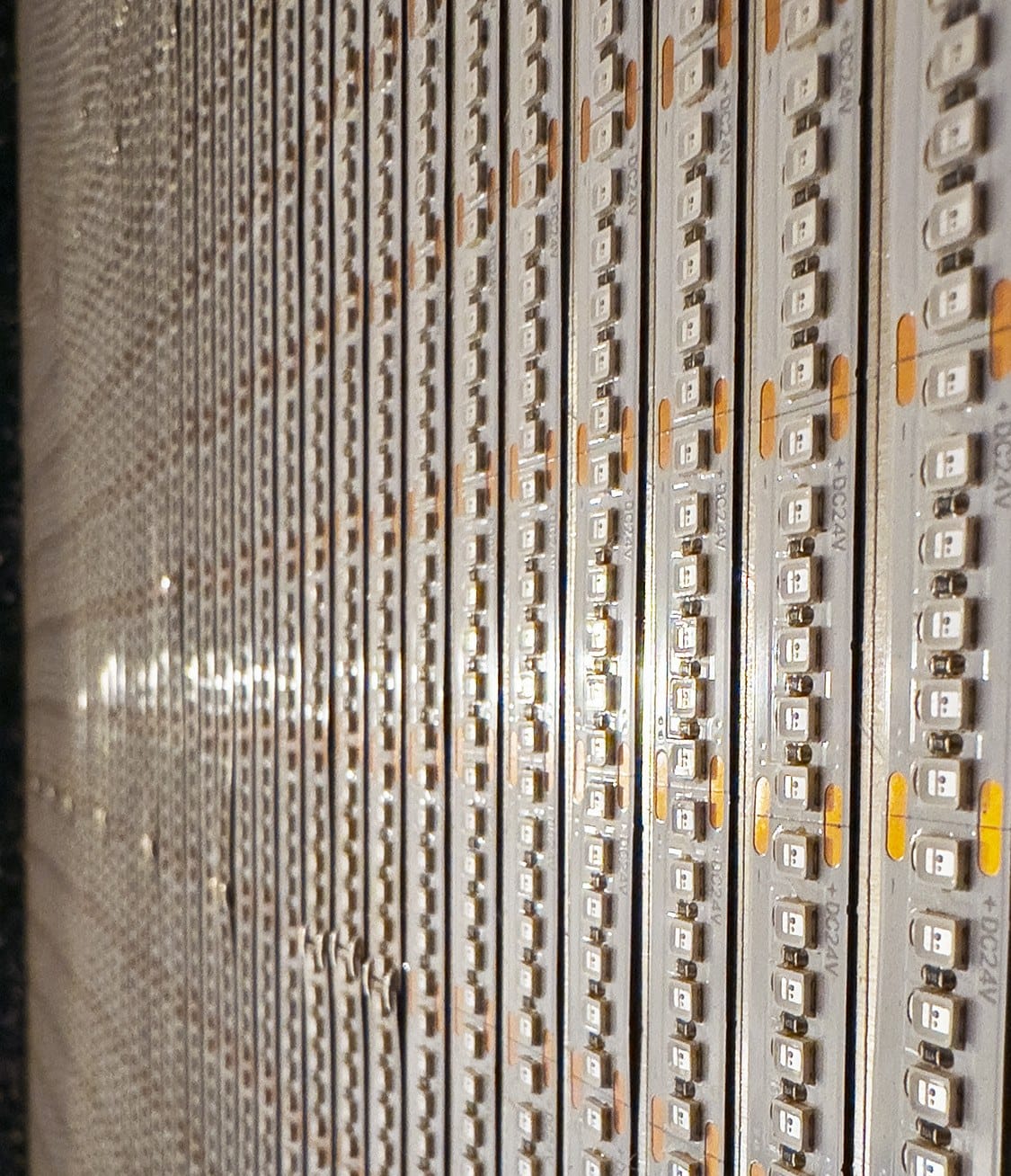
TRUE-365 is a high-output, 5-meter, 24-volt reel of true 365nm UV-A LEDs, built for exposing photopolymer gravure plates, platinum/palladium, cyanotype, gum, carbon transfer and other UV-sensitive processes. With 240 LED chips per meter, it gives you a dense, even light source for building an exposure unit at any size.
TRUE-365TM comes from Prints on Paper Studio, the Vermont photogravure studio that also supplies Torelief WS95HK2 polymer photogravure plates. Its output is verified at 3,000 to 7,300 µW/cm², depending on the voltage and amperage you supply.
For even exposure all the way to the edges, the LED grid needs to extend 2.5 inches beyond every edge of whatever you’re exposing. Without that overhang, the light falls off near the edges and the borders of your plate or print come out underexposed.
To size your grid, add 5 inches to each dimension of your plate. Here’s what that means for common plate sizes, up to 31″ × 42″:
| Plate size | LED grid size | Length needed (approx.) | TRUE-365TM reels | Min. 24V power supply | Min. supply current at 24V |
|---|---|---|---|---|---|
| 8″ × 10″ | 13″ × 15″ | 12.5m | 3 | 255W | 10.6A |
| 11″ × 17″ | 16″ × 22″ | 22.4m | 5 | 450W | 18.8A |
| 16″ × 20″ | 21″ × 25″ | 33.6m | 7 | 675W | 28.1A |
| 20″ × 24″ | 25″ × 29″ | 46.4m | 10 | 930W | 38.8A |
| 24″ × 36″ | 29″ × 41″ | 76.0m | 16 | 1,525W | 63.5A |
| 31″ × 42″ | 36″ × 47″ | 108.6m | 22 | 2,175W | 90.6A |
Strip lengths assume the densest layout, with strips about 1mm apart (10mm center to center). Reel counts are rounded up to whole reels. Power supply figures are 16W (about 0.67A) per meter plus 25% headroom for the strip actually used. Amps = watts ÷ 24V. Your supply, or your supplies combined, should be rated for at least this current at 24V. For larger units, splitting the load across several supplies is common. Wider spacing uses less strip.
TRUE-365TM packs 240 LED chips into every meter of strip, so the light sources sit close together along the strip. Lay the 9mm strips about 1mm apart in their densest configuration, and you get an almost continuous field of UV across the exposure bed. Dense light means more even exposure across the plate and fewer hot spots.
At that spacing, one 5m reel covers about 0.05 m² (roughly 77 square inches) of LED grid. For larger grids, add more reels and wire them in parallel. See “Sizing your LED grid” below for how much grid your plates need.
Most UV strips run on 12V. TRUE-365 runs on 24V. At the same wattage, a 24V strip draws half the current, which means:
To eliminate voltage drop completely, TRUE-365TM strips can be wired positive and negative at both ends. Feeding power from both ends keeps the brightness uniform across the whole length of every strip. Even illumination across the bed is what gives you even exposure across the plate, so this matters as much as raw output.
TRUE-365TM output scales with the power you give it. At the low end, around 3,000 µW/cm², you get gentle, controllable exposures for small plates and testing. At full drive, up to 7,300 µW/cm², you get short exposure times for production work. Pair the reel with an adjustable or dimmable 24V supply to dial in intensity for your process and keep exposure times in a practical range.
| Specification | TRUE-365 |
|---|---|
| Wavelength | 365nm UV-A |
| Operating voltage | 24V DC |
| Length | 5 meters (16.4 ft) per reel |
| Strip width | 9mm |
| LED density | 240 LED chips per meter (1,200 per reel) |
| Verified irradiance | 3,000–7,300 µW/cm², depending on voltage and amperage supplied |
| Power draw | 16W per meter (80W per 5m reel), about 0.67A per meter at 24V |
| Beam angle | 120° |
| Working distance | 2.5–7.5″ from the plate, with no measured change in irradiance across that range |
| Grid overhang | 2.5″ beyond every edge of the plate |
| Densest layout | Strips about 1mm apart (10mm center to center) |
| Wiring | Can be powered positive and negative at both ends to eliminate voltage drop |
| Rated lifespan | 50,000 hours |
| Included | One 5m reel and 20 connectors |
The best working distance for TRUE-365 is between 2.5 and 7.5 inches from the plate. In our testing, irradiance (µW/cm²) doesn’t change anywhere in that range. You can set the array height to suit your enclosure, vacuum frame or contact frame without your exposure times changing.
We strongly recommend controlling your exposures with a UV dosimeter, such as the Ian Leake exposure calculator, instead of a plain timer. As LEDs warm up during an exposure, their output dips slightly. A dosimeter measures the actual UV energy reaching the plate and ends the exposure when the target dose is reached. That gives you exactly the same exposure every time, whether the unit is cold or has been running all afternoon.
Use a regulated 24V DC supply with about 25% headroom over the total wattage of the strip you’re running. A supply working well below its limit runs cooler and holds its voltage steady, and steady voltage means consistent exposures.
365nm UV is mostly invisible but can damage eyes and skin. Run your unit inside a closed, light-tight enclosure. If you’ll be looking at or working near the lit array, wear UV-blocking safety glasses rated to ANSI Z87.1. Never look directly into the LEDs.
Note: under 365nm light, small components on the strip may glow a faint yellow or white. This is normal fluorescence and doesn’t affect output.
Here is the Build of Materials spreadsheet that we made for our own exposure unit at Prints on Paper Studio: https://docs.google.com/spreadsheets/d/1zvK_SmrW-yL8QTqpIV40MP5EJedxYv7wr396RYUFUO0/
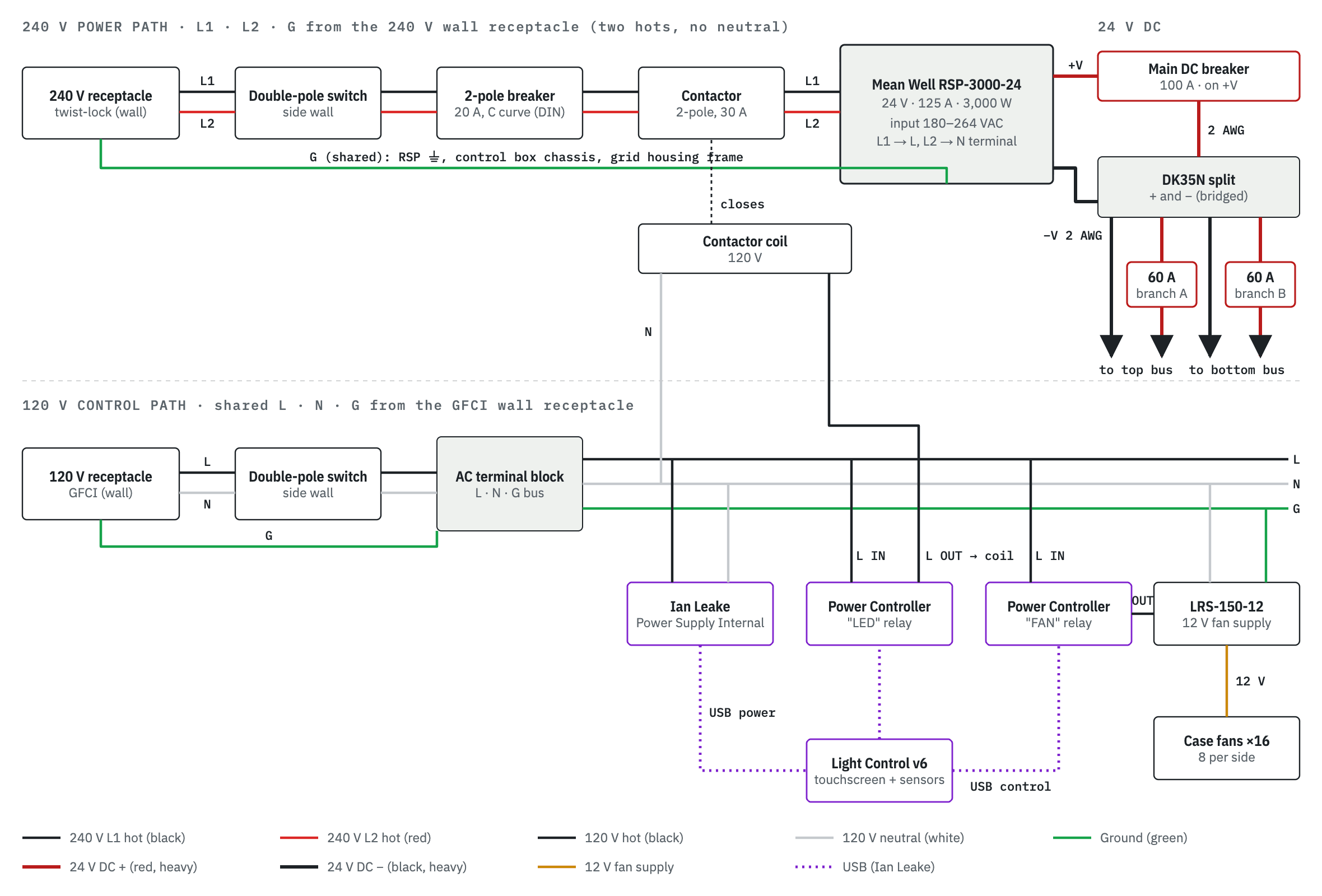
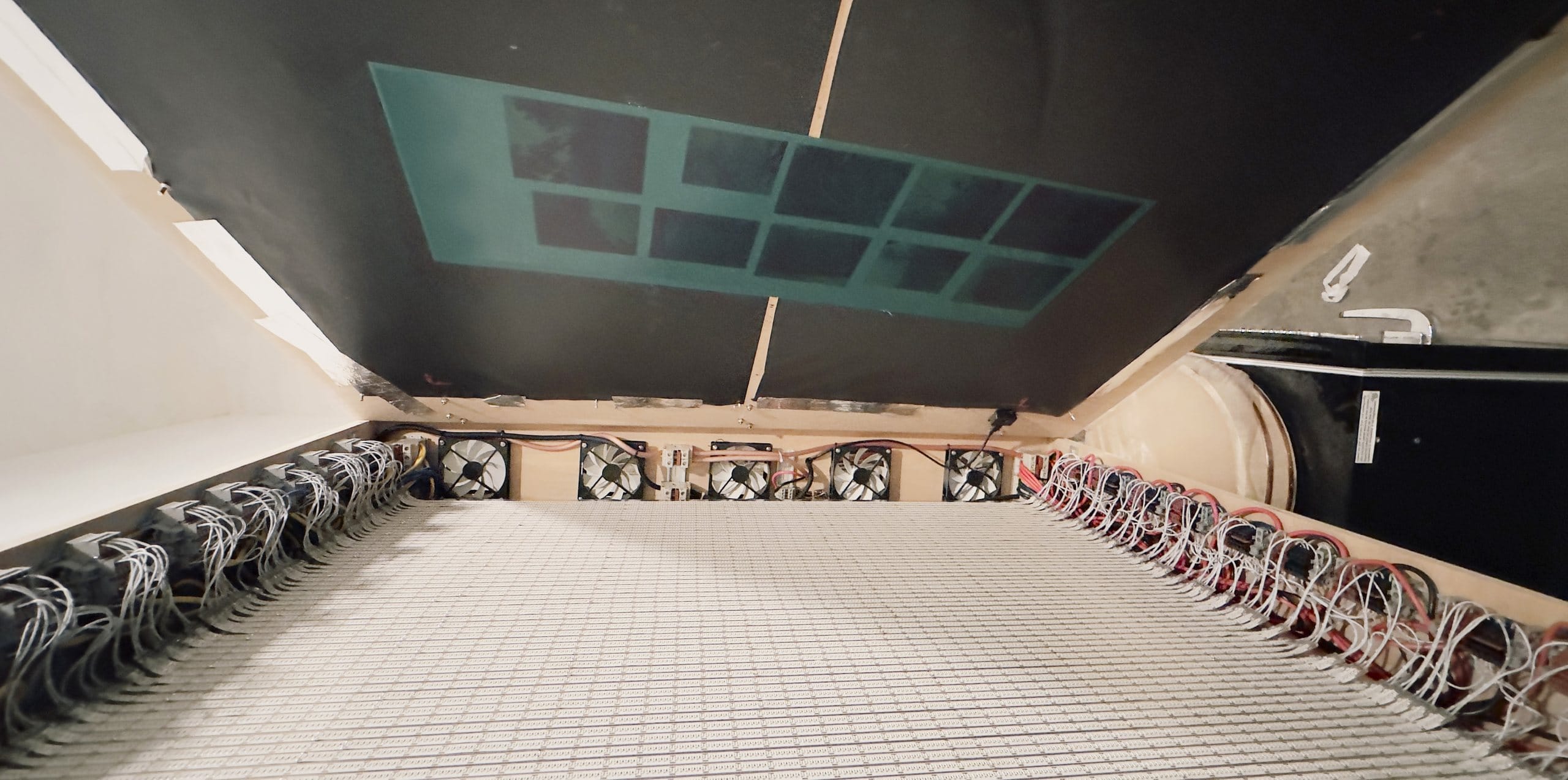
And below is the wiring diagram for both the power supply unit and the wall-mounted vertical exposure grid enclosure. The whole thing can expose plates at 31×42 inches in minutes and it only uses 8″ of horizontal space in a room because it’s all mounted on the wall. It does require both 120v and 240v wall outlets though!
Two separate AC circuits. The 240 V side is split-phase: two hot legs (L1 and L2, 180° out of phase) and a ground from the 240 V wall receptacle, with no neutral. Both hots run through a double-pole switch, a 2-pole breaker and a 2-pole contactor to the RSP-3000-24, where L1 lands on the L input terminal and L2 on the N terminal. Every 120 V part shares one line, neutral and ground from the GFCI wall receptacle through the terminal block, and those Ian Leake boards decide when the contactor closes and when the fans run.
The unit hangs upright on the wall, with the strips running vertically on the aluminum backing and a hinged plywood door on the front. Terminal rows run along the top and bottom so every strip is fed at both ends.
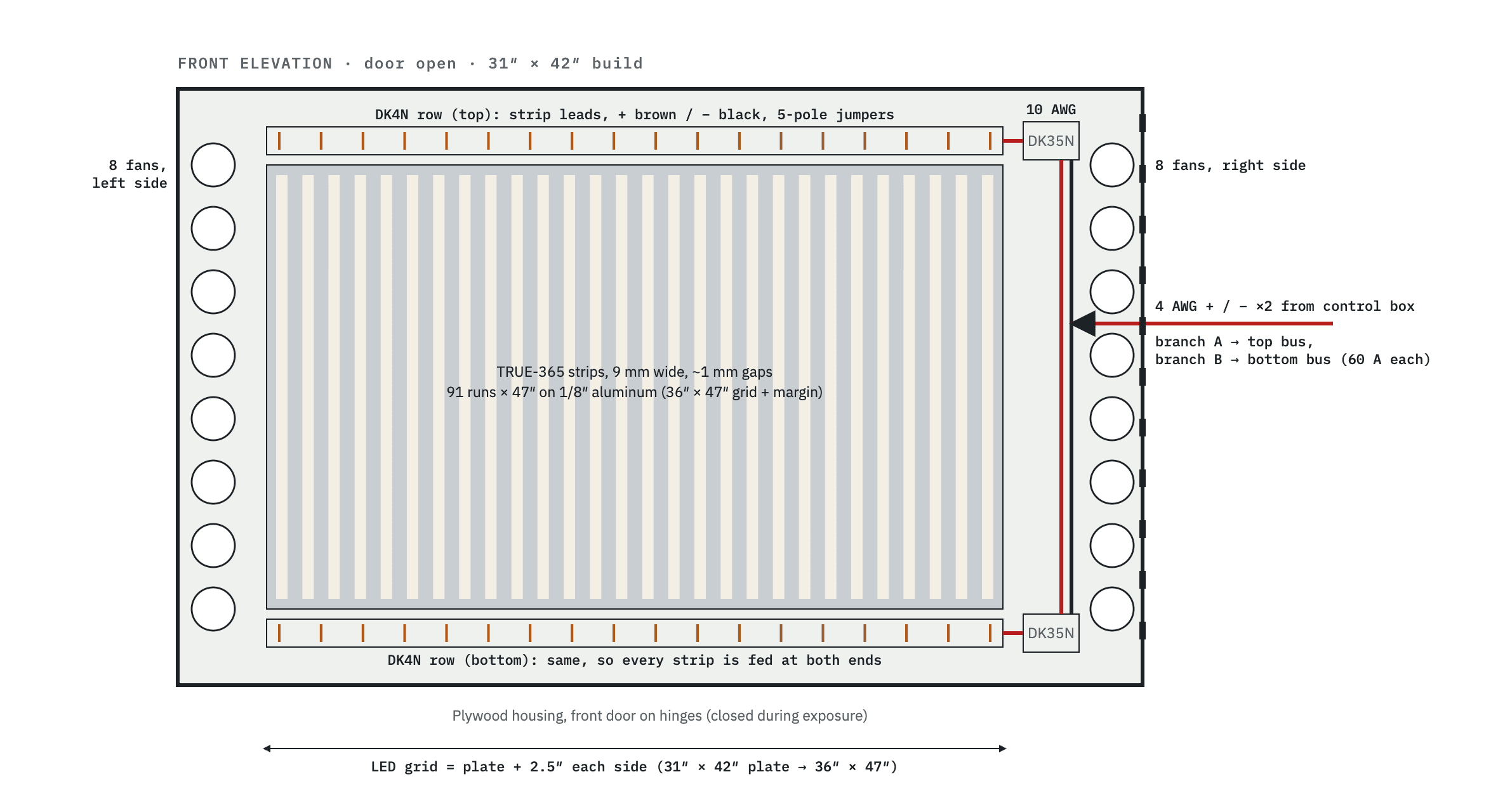

| Item | As built |
|---|---|
| Wall receptacles | The twist-lock receptacle is 240 V for the LED supply; the GFCI duplex is 120 V for the electronics. |
| Two side switches | One double-pole switch on each AC circuit, ahead of the breaker (240 V) and the terminal block (120 V). |
| Contactor coil | 120 V coil, fed from the “LED” Power Controller output and the neutral bus. |
| DK4N polarity | Brown terminals positive, black terminals negative. |
| Plate position | The plate is exposed in front of the strips with the door closed, within the 2.5–7.5″ working distance. |
This is a reference drawing of one studio build, not a certified schematic. The unit uses 240 V and 120 V mains wiring and high-current DC. Have a licensed electrician review the wiring before you build from it.
Can I use TRUE-365 to expose photopolymer gravure plates?
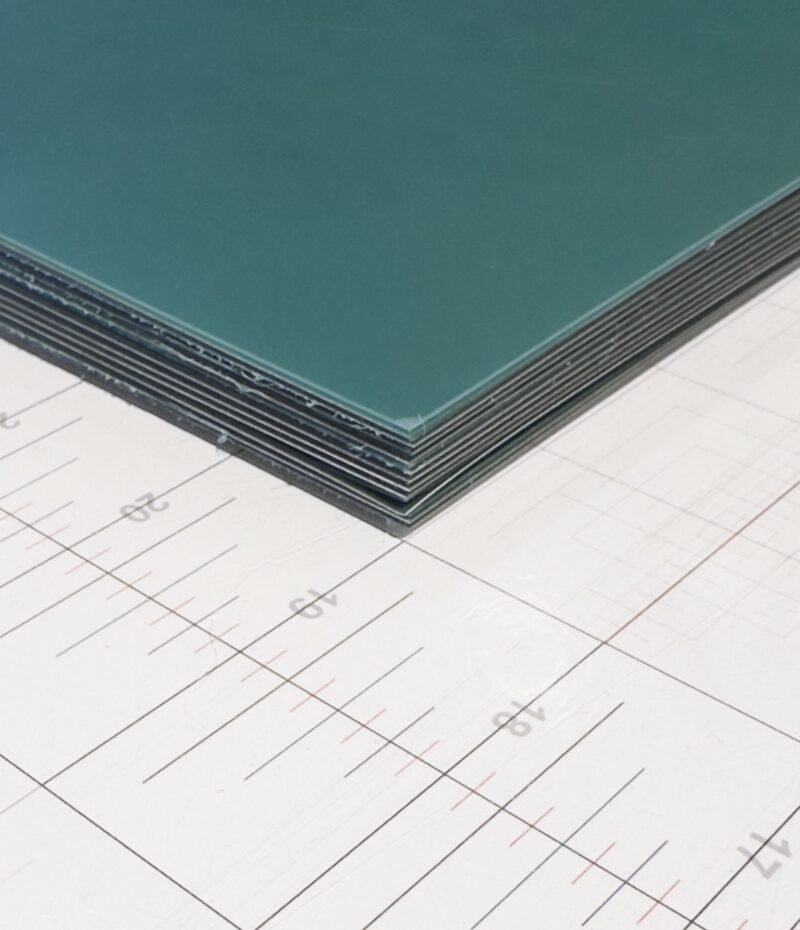
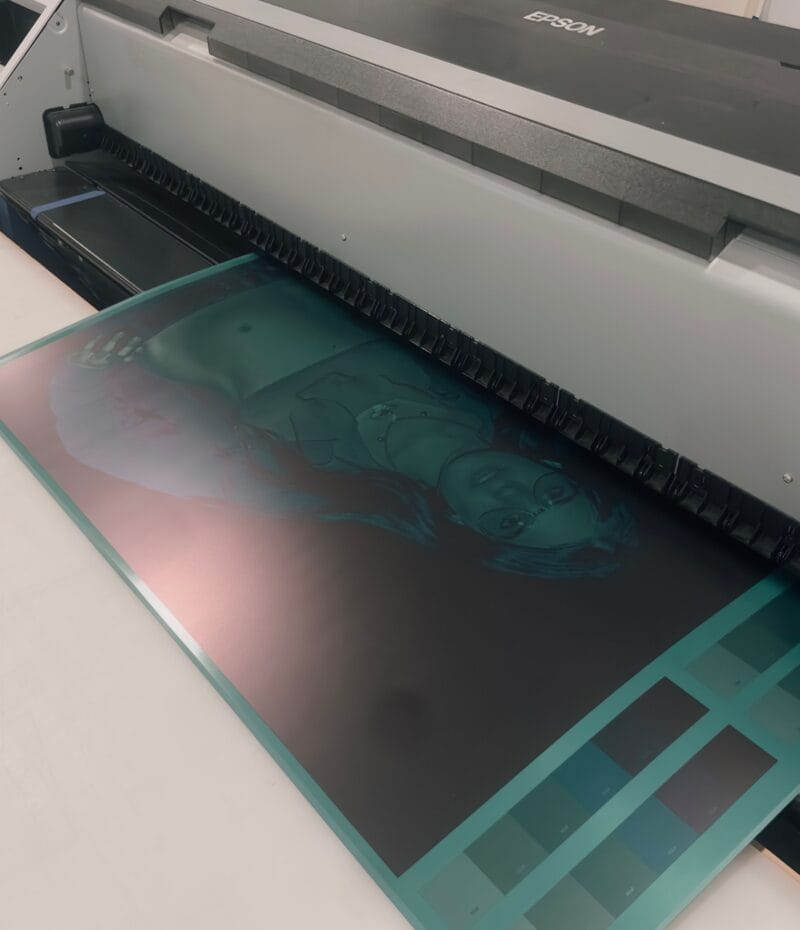
Yes. 365nm is well matched to steel-backed photopolymer plates like Torelief WS95HK2, for both direct-to-plate and film-positive workflows.
Does it work for platinum/palladium, cyanotype and other alt processes?
Yes. Platinum/palladium, cyanotype, Van Dyke, salt, gum bichromate, carbon transfer and photo emulsions for screen printing are all sensitive in the UV-A range that 365nm LEDs deliver.
How many reels do I need?
First size your grid: add 5″ to each dimension of your largest plate, for a 2.5″ overhang on every side. At the densest layout (about 10mm center to center), divide the grid width by 10mm to get the number of strip rows, multiply by the grid length, and divide by 5m. For example, an 8″ × 10″ plate needs a 13″ × 15″ grid, which takes about 12.5m of strip, or 3 reels.
How far should the LEDs be from the plate?
Between 2.5 and 7.5 inches. Irradiance stays the same throughout that range, so pick whatever height fits your frame.
Why do I need a dosimeter if the output is verified?
LED output dips slightly as the strips warm up. A timer gives the same seconds, but not necessarily the same dose. A UV dosimeter, such as the Ian Leake exposure calculator, measures the actual UV delivered and gives you exactly the same exposure every time.
Can I run TRUE-365 on a 12V power supply?
No. TRUE-365TM is a 24V strip and needs a regulated 24V DC supply. A 12V supply won’t drive it properly.
Can I replace the strips in my VerifiedUV™ or other 12V unit with TRUE-365?
Yes, but you’ll also need to switch to a 24V power supply, since the two systems run at different voltages. Re-calibrate your exposure times after switching.
How do I control the output?
Output depends on the voltage and current you supply. Use an adjustable or dimmable 24V supply to set intensity anywhere from about 3,000 to 7,300 µW/cm², and use a dosimeter to keep the total dose of each exposure consistent. The 16w/meter spec for these lights puts out approximately 7000 µW/cm² so if you are really wanting to up the voltage/wattage you need to make sure you spec a proper power supply with enough coverage. And also make sure you have the right heatsink and airflow in the unit!
Can I cut the strip?
Yes, but only at the marked copper cut points. Wire each section back to your supply in parallel.
In stock
Select options This product has multiple variants. The options may be chosen on the product page
In stock
Select options This product has multiple variants. The options may be chosen on the product page